
Consumer Scale
A vast and young population with diverse needs and aspirations.
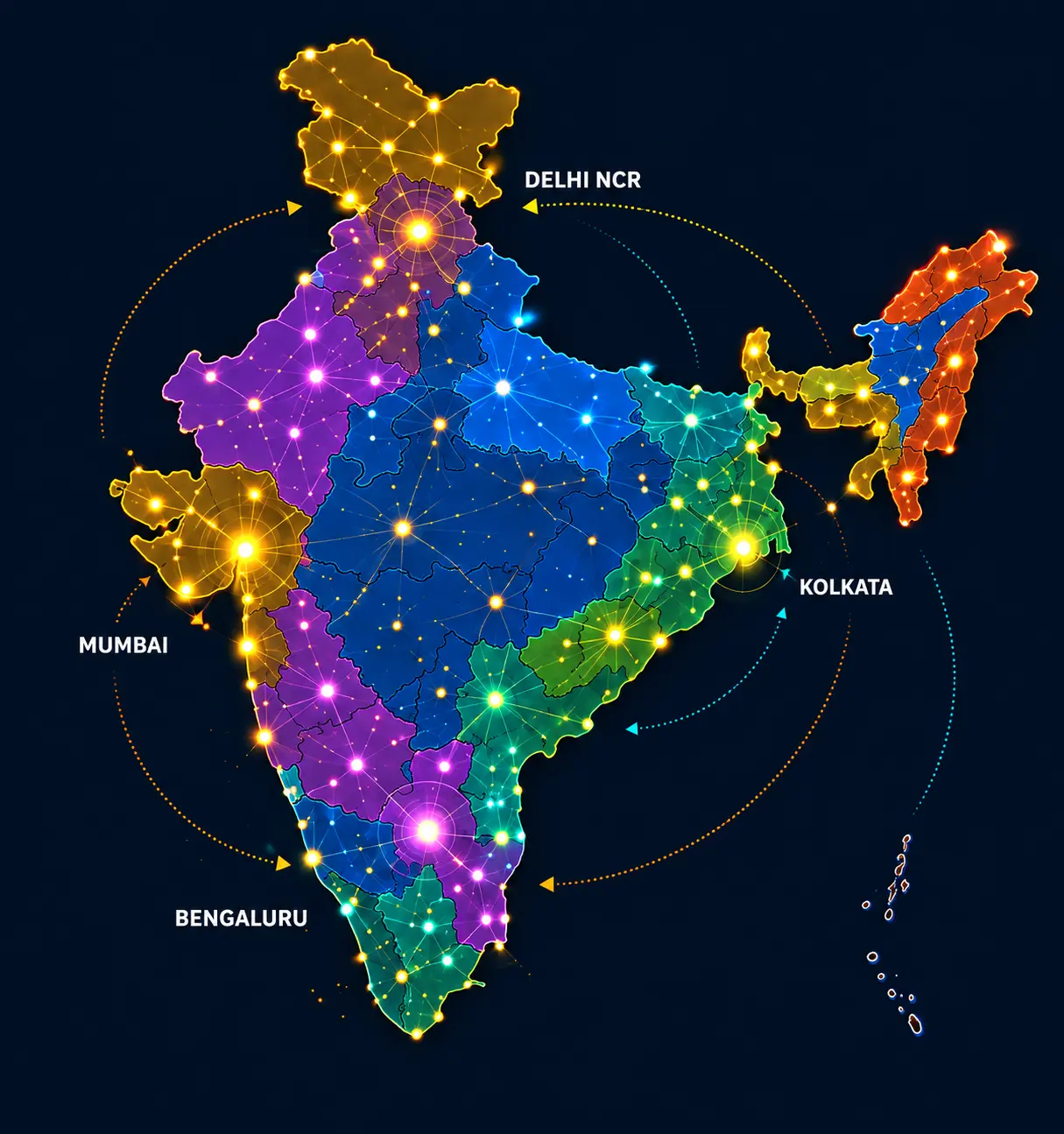
India combines the scale of a continent with the commercial diversity of many markets.
Its growth is being shaped by rising incomes, expanding digital access, rapid urbanisation, evolving retail channels and a new generation of consumers. But turning this opportunity into sustainable growth requires more than national ambition—it requires market-by-market choices and execution at ground level.
A vast and young population with diverse needs and aspirations.
Distinct consumption patterns across regions, cities and communities.
Multiple channels coexisting and evolving at different speeds.
Digital access and commerce driving new behaviours and expectations.
Multi-layered distribution structures with varying levels of control and efficiency.
Uneven maturity across markets, categories and channels.
India's opportunity is not based on population alone. It is the interaction of demographic scale, economic expansion, digital connectivity, urban development and changing consumption behaviour that makes the market strategically significant.
1.464 Billion
Population in 2025
UNFPA
6.4%
Projected Real GDP
Growth in 2026
IMF
1.0 Billion+
Internet Subscriptions
Dec 2025
TRAI
A population of extraordinary size—but with significant variation in income, language, culture and consumption behaviour.
India continues to rank among the fastest-growing major economies, expanding the addressable market across categories and channels.
Digital access is reshaping discovery, comparison, purchasing and consumer expectations across urban and emerging markets.
Growth is increasingly distributed across metropolitan, Tier 2 and Tier 3 city clusters rather than concentrated in a handful of national markets.
General Trade, Modern Trade, E-commerce, Quick Commerce, Wholesale and On-Premise operate simultaneously.
Many categories remain underdeveloped relative to India's population, leaving room for brands that create relevance, availability and repeat.
Sources: UNFPA, IMF, TRAI, World Bank
A national market view can conceal the differences that determine commercial success.
Consumer preferences, price sensitivity, retailer structures, category maturity, competitive intensity, media behaviour and route-to-market economics can change significantly across regions—and often between cities within the same state.
India therefore requires prioritisation, not blanket expansion.
The right question is not, “Should we enter India?”
It is, “Which India should we enter first?”
India's distribution system has evolved to serve enormous geographic reach and a fragmented retail universe.
Depending on the category, market and operating model, inventory may pass through combinations of importers, carrying and forwarding agents, regional warehouses, super-stockists, distributors, sub-distributors, wholesalers and direct accounts before reaching the consumer.
Each additional layer can extend reach — but can also reduce visibility, slow stock rotation, weaken pricing control and increase working-capital exposure.
Visibility matters. Every additional distribution layer can influence inventory movement, pricing discipline, service levels and working-capital efficiency.
Reach without control is expensive. The objective is not simply to add distribution layers, but to design the right route-to-market architecture for the category, geography and operating model.
India is not moving from offline commerce to online commerce in a straight line. It is developing as a hybrid system in which physical retail and digital platforms reinforce — and sometimes compete with — one another.
General Trade remains essential to neighbourhood availability and routine consumption. Modern Trade influences assortment, visibility and account economics. E-commerce drives discovery and range. Quick Commerce is changing expectations around availability and speed. On-Premise and institutional channels create distinct consumption occasions.
India is not an omnichannel market by default. It becomes one only when price, inventory and execution are deliberately coordinated.
India's next phase of consumer growth will not be defined only by the largest metropolitan cities.
Emerging urban clusters, connected smaller cities, highway and tourism corridors, specialised retail formats, digital marketplaces and new consumption occasions are creating additional routes to market.
The opportunity is becoming broader — but also more granular.
The next national winner may first emerge as a collection of highly productive local market systems.
New needs. New occasions. New value creation.
Most underperformance does not begin with a lack of ambition. It begins when a national strategy is built on assumptions that do not survive local market conditions.
National distribution is pursued before product-market fit, partner economics and replenishment are proven.
Large claimed networks are mistaken for service quality, outlet productivity and management capability.
Primary sales create the appearance of momentum while secondary movement, outlet activity and consumer repeat remain weak.
Channel margins, local price thresholds and consumption occasions are not adequately reflected.
Inventory, credit, ageing, trade investment and claims place pressure on both the company and its partners.
General Trade, Modern Trade, Quick Commerce and On-Premise are expected to operate under the same assumptions.
Market potential and category opportunity
Partner selection and commercial alignment
Supply, stock placement and availability
Service quality, execution and productivity
Availability, affordability and brand experience
Sustained purchase, loyalty and advocacy
Wrong market, misread demand or weak prioritisation.
Weak partner capability, misaligned incentives or poor governance.
Stock imbalance, high ageing, poor replenishment discipline.
Low service levels, no outlet coverage discipline, poor visibility.
Low availability, wrong price-pack, poor brand experience.
Low repeat, high switching, weak consumer connect.
Market intelligence, demand profiling and prioritised entry strategy.
Partner evaluation, viability assessment and performance frameworks.
Inventory planning, supply chain design and working capital optimisation.
Field execution, outlet productivity and trade activation systems.
Price-pack strategy, brand experience and consumer conversion levers.
Consumer insight, loyalty drivers and category development approach.
India rarely rejects a strong proposition outright.
More often, the commercial model fails to deliver it consistently.
Sustainable growth in India requires an operating system that combines strategic consistency with market-level adaptability.
Enter the markets where opportunity and execution readiness intersect.
Build structures in which every critical partner has a reason and the capability to perform.
Define assortment, pricing, service and investment according to channel economics.
Translate distribution into availability, visibility, recommendation and repeat purchase.
Connect market, distributor, inventory, channel and field observations.
Expand only after demand, replenishment and economics have been validated.
Consistent value creation through the right commercial system, executed at the right level.
Data-led segmentation and prioritisation to focus where opportunity and readiness align.
Right partners, clear roles, viable economics and strong enablement for mutual growth.
Channel strategy, customer plans and go-to-market models tailored to channel economics.
Field execution, outlet productivity and brand experience that drive consumer repeat.
Integrated information and analytics for proactive decisions and course correction.
Disciplined expansion with controls for inventory, profitability and partner performance.
Understand local consumers, retailers, competition and economic reality.
Consistent processes, policies and performance management.
Capabilities, tools and incentives that unlock partner potential.
Working capital discipline, risk management and leakage prevention.
Continuous feedback loops to adapt strategy and execution.
Build equity, relationships and systems that competitors find hard to replicate.
Winning in India is not about simplifying the market.
It is about building a system capable of managing its complexity.
FACSPRO brings together senior commercial experience, India-market understanding and execution capability.
We do not treat market entry, distribution, channel growth and performance as separate conversations. We connect them into one commercial system—from strategic decision to outlet execution.
Engagements are shaped by leaders who have built and managed businesses across Indian channels and markets.
Our recommendations reflect distributor economics, retailer realities, channel structures and field execution.
We help activate partners, teams, operating routines and performance systems—not merely define them.
Market signals, channel performance and execution observations remain connected to management decisions.
COMMERCIAL OPERATING SYSTEM
Market, consumer, category and channel intelligence.
Entry strategy, RTM, partner model and economics.
Distribution, channel launch and field execution.
Inventory, productivity, partner health and commercial outcomes.
Metro, Tier 2, Tier 3 and emerging clusters.
Aligned partners extending reach and driving sell-out.
Availability, visibility and recommendation at the outlet.
Marketplaces, e-commerce and quick commerce fulfilment.
On-ground execution, merchandising and partner development.
Trial, repeat and loyalty driving sustainable growth.